Hi there, colleagues in China!
I tend to avoid looking at the analytics for this site. It's sometimes funny to see which search terms bring people to my nook of the internet. But I try to avoid trying to see which posts are more 'catchy' than others, because I don't want to catch myself pandering to SEO. On the occasional moment when someone told me that a certain post was very useful/validating/thoughtful, it's usually the ones that don't get circulated as much. I'd rather helpful than popular. Both is fine but I don't want the latter to come at the cost of the former. Knowing too much about what makes this site popular is probably a bad thing for the writing.
With that caveat aside, you know what I'm about to say. My look at the stats pretty much blew my mind. Take a look:
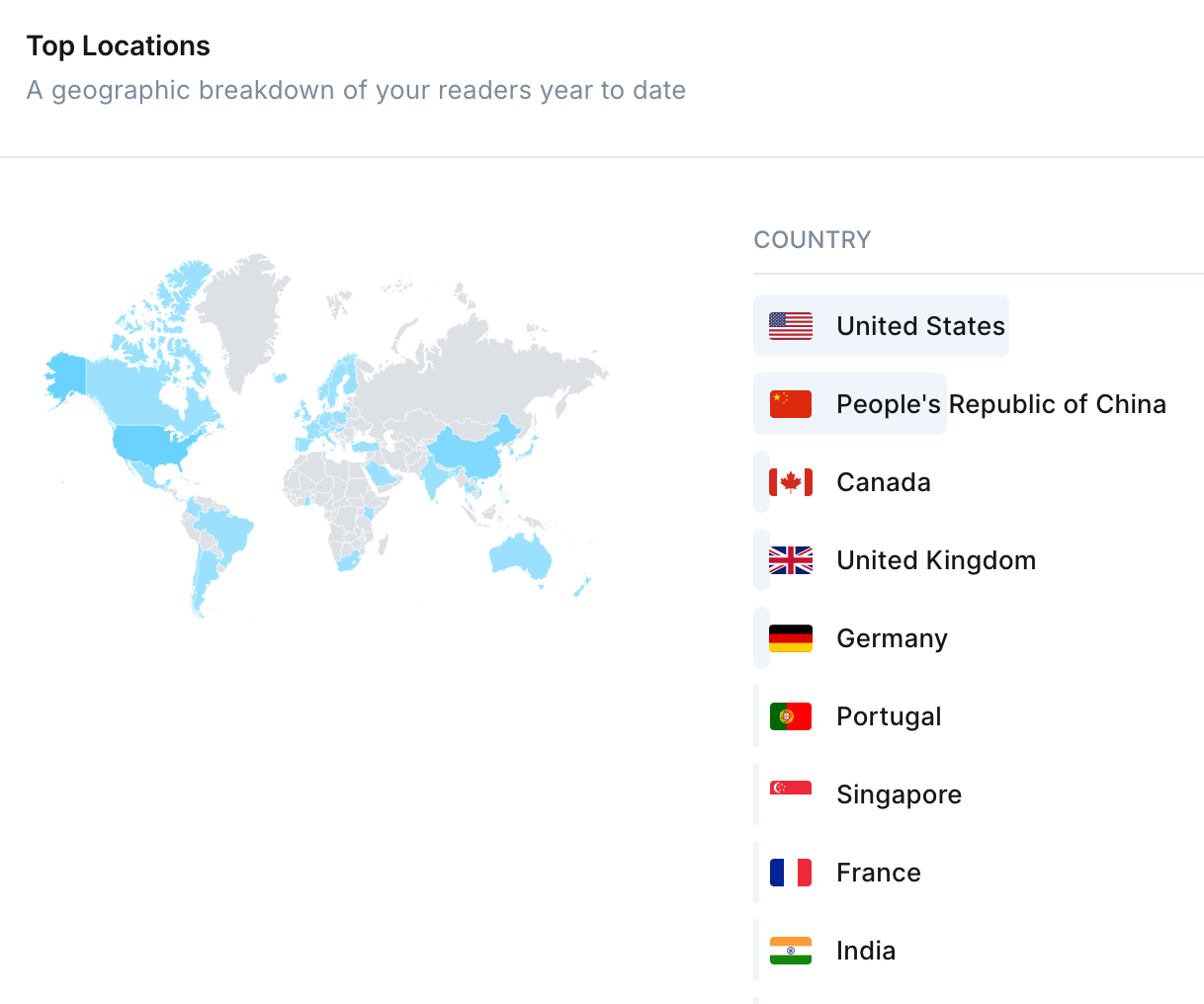
It looks like Science for Everyone has a substantial audience in China – far more than in Canada! Because so much of what happens here is about how science and higher education as things play out specifically in the US, I've understood why folks outside the US aren't reading as much. But this site has a strong readership in the PRC?! How about that.
I took a little bit of time to dig in just to be sure that it's actually a bunch of people from across the country who are visiting, but that's apparently what is going on. Looking back at my stats when I was hosted previously on substack [2024-2025] and wordpress [2013-2024], there was a scant readership from China. So it's happened within the past year.
So to my science colleagues in China: Howdy! Welcome! Glad to have you aboard. Hopefully our paths will be able to cross at some point.
And I think most of us are aware that China's prominence in scientific research will soon surpass that of the United States, which is likely to be quantifiably true with respect to financial investment within the next two years.
Meanwhile, forces at work in the United States federal government have done their best to crush our research institutions, eliminate our scientific workforce, and put up barriers to ongoing and new collaborations with international colleagues. The scope of our self-inflicted injuries is still hard to come to terms with. It's clear, however, that even if we manage to get people in positions of power to restore what we've lost, it's been a generational harm that we can't fix overnight. You can't shut down science with a switch and then turn it back on, because real human beings are doing science. We've lost 10,000 STEM PhDs working for the federal government alone, not even counting the folks who have left industry, universities, and the redirection of new trainees away from STEM.
I've not yet had the pleasure of working closely with scientists based in China. I'm bummed that I'm not available to go to the tropical biology meeting this [northern hemisphere] summer in Xishuangbanna. I suppose that would have made for some tremendous opportunities to build connections. I missed out the last time ATBC was in China in 2006 as well. My cloosest scientific society is very international but we've done a poor job building community with fellow researchers in China. (And also, oddly enough, Mexico.) I imagine that any global scientific enterprise that continues to overlook building connections in China will grow to be more marginal over the coming years, considering that China is investing to position itself as the epicenter of scientific progress.
As my own federal government is forfeiting its position of scientific prominence, it makes sense for those of us in places with fewer resources and training opportunities to look abroad for support, training, and collaboration. I'm not sure hnow many of you realize that my own state, on the other hand, has taken cue from our federal collapse to consider investing in our own infrastructure by creating a California Foundation for Science and Health Research that would hopefully replace what is being taken away from us at NSF and NIH. Let's hope that California voters agree that this is a critical step for the vitality of our state. Regardless, wherever we are in the US, the importance of international collaboration has become even more important.
How will this lil' revelation of mine change what I'm doing here, in terms of theme, approach, and askew references to less common idioms? Not at all, at least not consciously. When I write these posts I do a pretty good job of forgetting who is on the receiving end. If I failed at forgetting, then I'd be so nervous I'd be frozen at the keyboard. I'm not sure to what extent the Chinese readership of this site has direct experience working in the US or with US-based collaborators, but I would guess that they're here to gain a greater understanding of this environment. So I'll simply keep on keepin' on.
Member discussion