Submit your OMB comment this weekend.
It's hard to imagine that you're a subscriber of Science For Everyone and not know about the proposed OMB rule that will wholly corrupt the foundation of our scientific funding infrastructure. No, that's not hyperbole. But if you haven't, here's a very cogent summary (on a substack site).
But have you submitted your comment yet?
It's been posted in the Federal Register as official stuff is required to be, and the comment period is open until Monday. Sorry for the short notice, but if you personally haven't submitted your own comment, please do so this weekend.
A good comment can only take a few minutes.
An extremely simple and straightforward form is accessible thanks to the folks at Stand Up For Science: Again, this link is that form, and it can take you only a few minutes if you do it this way.
Note that the OMB is required to review and respond to substantive public comments, so make sure your comment is substantive. You should have evidence-based insights and ask questions that require answers. An example from my comment is below. Let me give you a big pro-tip here on drafting your comment: it's not wrong to use AI. Lord knows they'll be using it to craft the responses to these comments. What AI can do is fluff out the serious point that you're making and pull together evidence, additional arguments, and the language that they will need to see that makes your comment "substantive" in their view. Make sure that you're using arguments, language, and approaches that are speaking the language of the people who are looking to destroy science.
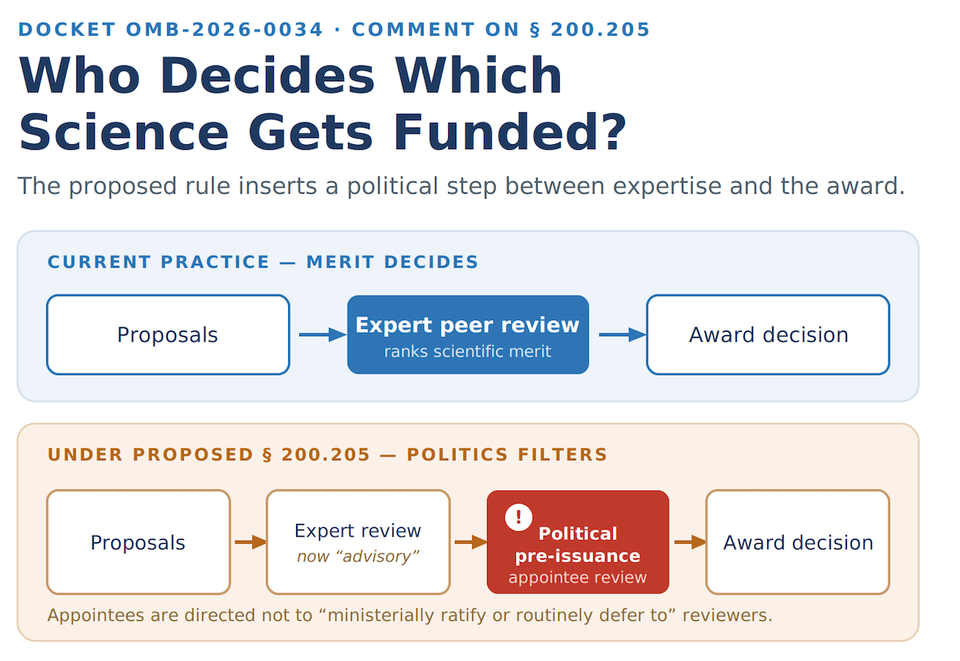
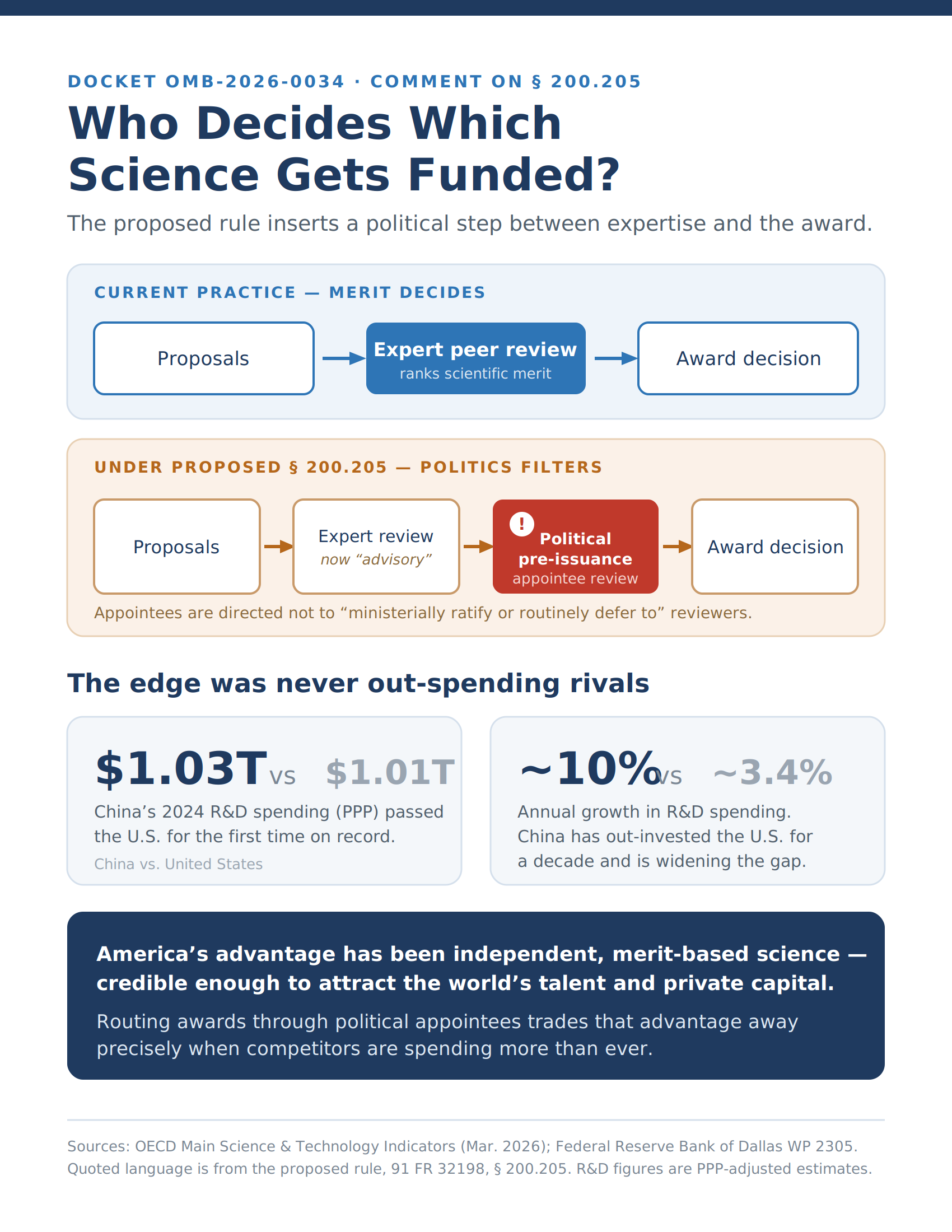
If you go directly to the OMB site to make the comment, then you can upload documents as supporting evidence, infographics, etc. For example, in addition to my comment (which focused on the financial returns of independent research without political interference and our capacity to compete with China in various ways), I got AI to cook up a couple infographics to accompany the comment, which are below, if you'd like to get the gist of my comment.
Again, make sure there is enough substance in your comment that compels them to provide a response. As of this writing, there are over 100,000 comments. I am guessing a lot of them will be non-substantive.
Here was my comment, which might inspire you to find other types of arguments. This might look like it took a lot to draft but with Claude, it honestly took me a few minutes. (I would like to reassure you that I will never, ever take such an approach when I ask for funding from NSF or in peer reviewed manuscripts.):
I submit this comment as a scientist who has served as a peer reviewer of research and emerging-technology proposals for the National Science Foundation. I write to oppose the changes to § 200.205, which require senior political appointees to conduct a “pre-issuance review” of all discretionary awards, instruct them not to “ministerially ratify or routinely defer to” peer reviewers, and demote peer review to “advisory.” I respectfully request a substantive response to the empirical and economic concerns below.
1. 1. The rule misidentifies the source of return on research investment. Federal R&D produces extraordinary economic value precisely because award decisions track scientific merit rather than the priorities of whoever holds office. Recent Federal Reserve Bank of Dallas research (Fieldhouse and Mertens) estimates that nondefense government R&D has generated aggregate returns of roughly 140–210 percent and accounts for about one-fifth of all U.S. business-sector productivity growth since World War II—a higher rate of return than public infrastructure. The mechanism that delivers those returns is expert evaluation of which proposals are most likely to yield reproducible, high-impact results. Inserting a political filter ahead of that mechanism does not improve it; it degrades the very signal that produces the return. I request that OMB identify the empirical basis for its apparent assumption that senior-appointee review will improve, rather than diminish, the productivity returns documented in this literature.
2. 2. The rule will reduce GDP through misallocation and delay. Productivity gains from R&D arrive with long lags—the Dallas Fed work finds effects emerging roughly eight years after appropriation. Politically directed selection raises two distinct costs: (a) misallocation, as funds flow toward proposals favored on non-scientific grounds rather than expected scientific value, lowering the portfolio’s expected return; and (b) delay and uncertainty, as appointee review becomes a bottleneck and applicants cannot predict whether technically excellent work will be funded. Both effects compound over the multi-year lag, meaning a measurable drag on future total factor productivity and GDP. I request that OMB’s final rule include a quantitative estimate of the productivity and GDP effects of substituting appointee judgment for merit ranking, given the magnitude of returns at stake.
3. 3. The rule undermines U.S. competitiveness at the worst possible moment. In 2024, China’s gross R&D expenditure reached approximately $1.03 trillion (PPP-adjusted), surpassing U.S. spending for the first time, and China has been increasing R&D at nearly 10 percent annually—roughly triple the U.S. rate. China’s comparative advantage is scale and direction; America’s historic advantage has been the credibility and independence of its research institutions, which attract global talent and private co-investment. Politicizing grant selection erodes exactly that advantage, signaling to researchers and firms that U.S. funding may turn on shifting political tests. I request that OMB address how appointee pre-issuance review affects U.S. ability to attract and retain top researchers relative to competitor nations.
4. 4. Scientific independence is fiscally and politically prudent for this and every administration. Insulating merit review from political appointees is not a partisan position—it protects each administration from funding scientifically weak but politically convenient projects that later produce no results and invite oversight criticism. The returns documented above accrue regardless of which party governs. A durable, merit-based system also shields the administration from the reputational and litigation risks of awards that appear ideologically selected. I request that OMB explain why a structure that exposes award decisions to political attribution serves the taxpayer better than one that preserves expert primacy.
5. 5. The “advisory” framing inverts sound design. Directing appointees not to “routinely defer” to reviewers treats subject-matter expertise as a presumptively suspect input. In frontier and emerging-technology fields, appointees will rarely possess the specialized knowledge to second-guess reviewers without degrading decision quality. I request that OMB clarify what qualifications appointees must hold, what record must document any departure from peer-review recommendations, and how such departures will be audited for cost-effectiveness under § 200.303.
For these reasons, I urge OMB to withdraw the pre-issuance review requirement and restore the determinative role of merit review in § 200.205.
Submit your comment to OMB today
Member discussion