The awesomeness of museums
A child of the '80s, I may be generationally locked into calling everything awesome. Friends around me would know better than myself - I know I say "dude" aplenty, but what about "awesome?" I dunno.
But let's talk about genuine awe. Like the Laura-Dern-and-Sam-Neill-when-they-see-the-dinosaurs-in-Jurassic-Park kind of awe. When have you been driven awestruck? (There is a comments section, please make avail.)
I'll go first. Though dry behind the ears, I do my best to retain a sense of wonder so I might get awestruck more easily than all y'all jaded folk. My moments fall unambiguously into two categories: nature and museums.
The nature ones¹ are what you might expect: stunning landscapes and creatures, both botanical and animal. It's the museum moments that sear into me deeper than natural history moments. I'll try to write about it, but the impact is the experience of the artifact itself. The actual thing, sitting right there. There's no substitute.
I want to tell you a few stories of these museum exhibits and what they did for me and to me, what they have been for me.
You might already know about the epic wall of dire wolf skulls at The La Brea Tar Pits in Los Angeles. (And yes, the name of the place is "the La Brea Tar Pits," which translates to "The The Tar Tar Pits.")
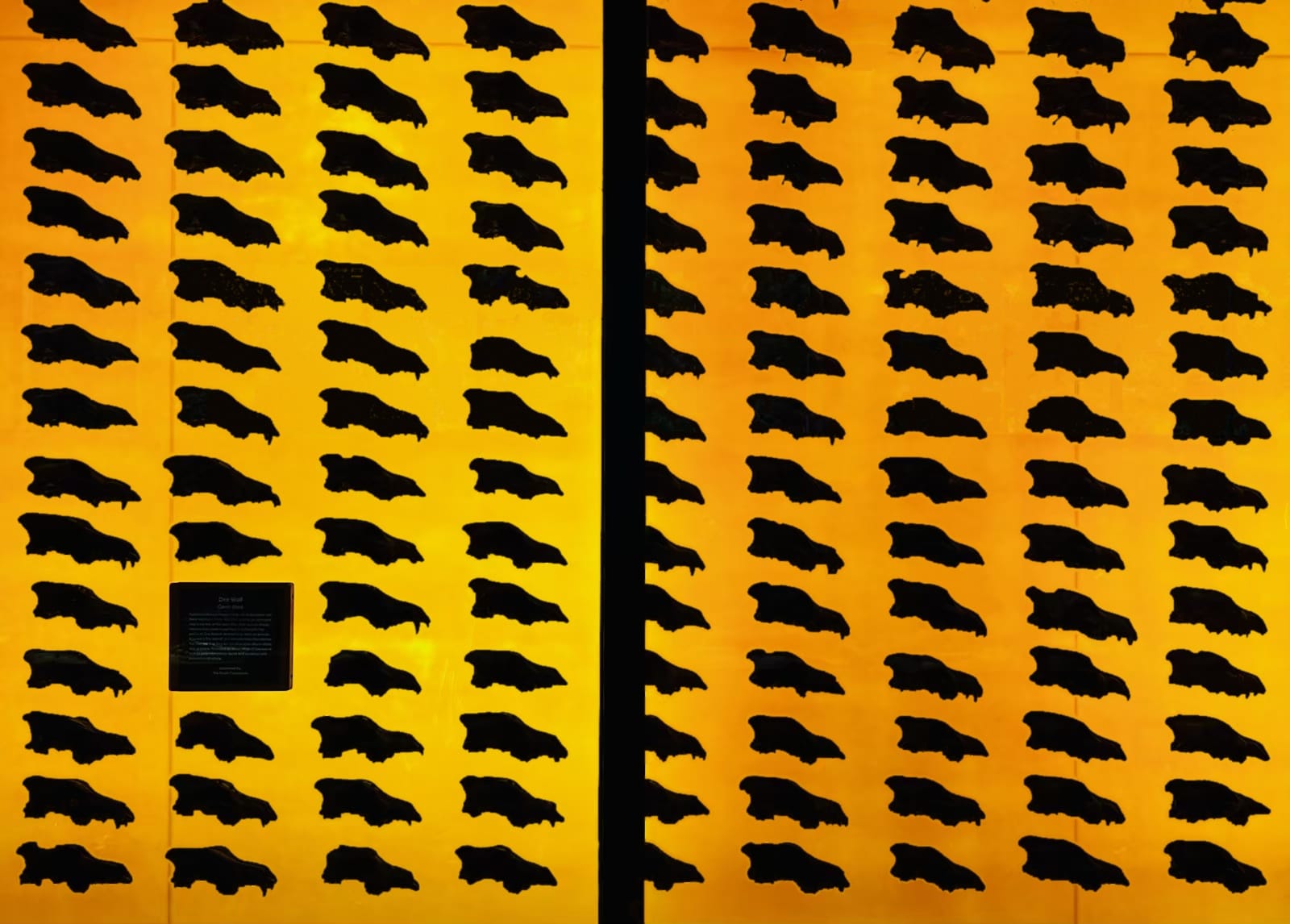
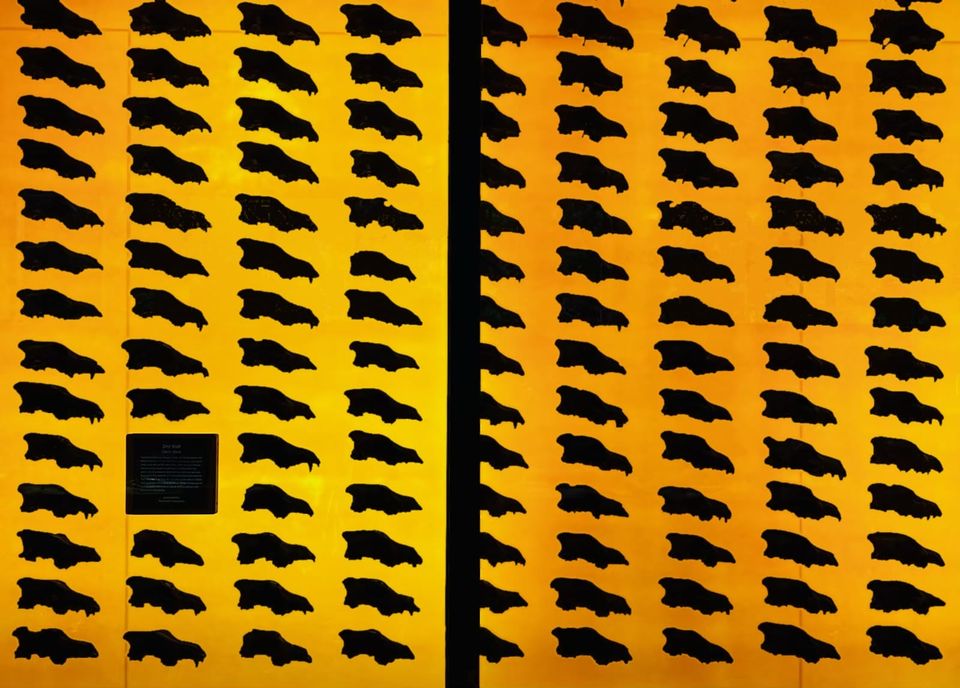
This exhibit in the middle of Los Angeles may well be the reason I became a biologist. Obviously there were other places, people, and moments, but as a child in elementary school, it filled me with wonder, curiosity, and excitement. And again in high school, and college, and the more recent time, a year ago. Just as people had made their way to what we now call Los Angeles, open pits of tar trapped all kinds of spectacular and now extinct creatures – mastodons, mammoths, American camels, American cheetahs, saber tooth cats, giant ground sloths, and dire wolves. Pieces from more than 4000 dire wolves have been pulled out of the tar so far. A sizeable subset of their skulls are mounted in this display, which doesn't appear to have changed in the last 40 years. As it should - it's a legendary display and it's perfect. It inspires so many questions about history, research, ecology and evolution. How many times was I thinking about this exhibit when I was in college taking conservation biology, biogeography, biostatistics, evolutionary biology?
I've got five more museum stories. They had such an impact on me, I feel like I have to tell them:
I surmise that a strong majority of you are familiar with the saga of the Shackleton's 1914 Antarctic expedition. (If not, it's worth reading a book about it, arguably the most epic tale of survival and leadership, a stunning combination of determination, luck, skill, and hope. If you're not familiar, you're in for a treat. It has a happy ending, unless you're in love with Mrs. Chippy the cat as I was.) When I was in grad school I read a few books about the story of the crew of The [aptly named] Endurance, including Shackleton's memoir. When I was living in the DC area in 2000, I went to an event at the National Geographic Society's museum. I was surprised to discover that they were hosting a traveling exhibit about the Shackleton saga! How did I not know it was there? Well, it was easier to be oblivious considering we were not perpetually online back then and a lot of things simply weren't yet online. In addition to the full set of photos that survived (interesting long story itself), there were a bunch of other artifacts from the trip and a well-curated exhibit about the whole thing. Very cool. Then, I rounded the corner to the last room of the exhibit and turned Sam-Neill-in-Jurassic-Park agog. The actual James Caird was on display. This is the small vessel that made the most improbable and stunning journey in the most wild circumstances, from Elephant Island to South Georgia Island. The actual boat that went on this most extraordinary journey. You can picture what it was like to be in there with them 75 years ago. (Now, a century ago.) In the room were some electronic sextants and projections demonstrating the waves and the shifting horizon and the dim glow of the sun obscured by the storms, so you could try your own hand at attempting to navigate the James Caird and find out where you would end up (spoiler: not South Georgia Island). This exhibit exists so strongly in my memory but there is only the slightest trace of its existence online, in a couple buried mentions. If you want to see the James Caird nowadays, it's on display at Dulwich College in London.
I don't remember when I saw my first Rothko. But there is a reason that museums give them their own wall, and put a bench about ten feet away from it. If you look at a photo or a print of a Rothko, it's maybe interesting, perhaps meh. But a Rothko in person? The saturated colors, the shifting horizon, the depth, the fullness? If I'm feeling a deficit of awe, I look for a Rothko. (I am currently geographically blessed as I'm not far from the East Wing of the National Gallery of Art, which has a substantial Rothko room in which they rotate their substantial collection.)
One of the most remarkable museums is the American Visionary Art Museum, in Baltimore. There was a traveling exhibit there (apparently in late 2006) that featured Agnes Richter's embroidered jacket. She was institutionalized for the last 25 years of her life, and over the decades she secreted away stray threads and wove in snippets of memory from her prior life and affirmations of her existence. You can look at a photo online, but seeing it in person, you don't just know her story, you get a slight hint of feeling it and a slight wisp of understanding her lived experience.
My favorite museum might be the Museum of Jurassic Technology. (If you know, you know. I've tried to describe it before.) One gallery is a set of beautiful oil portraits of dogs. Which may well be expected, as anything may be expected from the MJT. After several initial seconds I clocked who these dogs were: their lives were taken for the Soviet space program. The portrait of Laika was adorned with a memorial candle. I might cry a bit easily but how can one not when you see the love and care put into these works of art honoring their subjects, contrasted with how they were abandoned alone in space by those who had once cared for them.
Museums make us feel as we grow with new experiences. As more of our lives take place on screens, the tangible nature of museums and the power of artifacts can help us connect with our own humanity².
Natural history museums are no exception. I've spent two years of sabbatical based out of the Natural History Museum of LA County, and a bright part of this experience was weaving my way through the public exhibits, typically packed with school groups with kids who were downright thrilled. Many of them are having moments not unlike I had with the dire wolf skulls. Well, some of them are.
The continued operation of most museums and natural history collections is perennially at risk, as they're operating on thin financial margins. Many are just one bad director, one huge lawsuit, one natural hazard, or one infrastructure shortcoming away from closing. Some places have impressively huge endowments and are built to withstand inevitable ups and downs, but most institutions and most collections (and most museum employees) don't have such security.
Museums and biological collections that are based out of universities may be uniquely insecure at the moment. In an earlier era, the development and maintenance of scientific collections was an integral part of the the missions of universities. While I believe that universities still must be very much at the heart of museums, outreach, and scientific collections, we have to recognize that it's become a harder sell to the people who are working to keep the doors of the universities themselves open.
In recent years, we've seen a variety of universities choosing to divest from their biological collections. The University of Louisiana Monroe unceremoniously ditched their herbarium and their ichthyology collection. UC Riverside shipped its lichen collection up to the Santa Barbara botanic garden, and the University of Mississippi decided that their insect collection was no longer worth the support. Duke decided to shut down their 100-year old herbarium. (After more than two years, word recently came out that UNC is taking it all in.) The former director of Duke's herbarium said, "Refusing to fund it, then handing it off, isn't stewardship — it's dereliction." You can learn more about threatened and orphaned collections from the folks at the Society for the Preservation of Natural History Collections.
You might have been hearing about another university-operated natural history museum that is threatened with closure. Of course it is the Sternberg Museum of Fort Hays State University.
Also, there's one of the oldest natural history museums in the country, the Academy of Natural Sciences in Philadelphia, which supposedly shut its doors to the public yesterday. However the greater threat is what may happen to the building and its collections under Drexel's leadership. When was the last time an economist was appointed university president and left the place better than when he arrived? You know how I said some small fraction of museums were blessed with huge endowments and could withstand anything. That is not the Academy of Natural Sciences. Despite its age, it's not as robust as the American Museum or the Field museum. Drexel took over the Academy just fifteen years ago. One wonders why the University of Pennsylvania, which is right across the street from Drexel and has an endowment that is about 30 times greater than that of Drexel, didn't take on the Academy? I'm sure an approach was made.
The bottom line is that every major natural history museum in the United States has either a massive endowment (e.g., Field, AMNH), or at least a very clearly defined if modest public support mechanism (e.g., NHMLAC, NMNH, DMNH to some extent). Those that have neither, such as the California Academy of Sciences, are in a precarious position and it looks to me like they at risk like the Academy of Natural Sciences is.
Drexel took on a museum that needed to rely on the financial strength of the university's endowment and the larger resources of the campus. But they had a change in administration and the leadership apparently thinks that the museum is an anchor instead of a resource and an integral part of the mission. Plainly put, that sucks. The current administration of Drexel needs to honor the commitment that was made only 15 years ago by their priors. The university bought this problem, it's on the university to fix it rather than abandon it. But to be clear, it doesn't have to be a problem – it's a tremendous asset! It simply needs strong leadership to reap the rewards of operating one of this most historic scientific collections and public museums in the country. It won't be an overnight journey but the ceiling is so high, and the people of Philadelphia deserve that leadership.
Kudos and thanks to those who have been raising the temperature on the situation in Philadelphia. I think the Academy of Natural Sciences is such a treasure that the people of Pennsylvania and of Philadelphia should be investing into its continued success, and Drexel needs but a shift in perspective to understand the treasure that is sitting in their very own laps. It appears that at the beginning of this month, they brought in an interim leader who has experience fostering economic stability and growth in the informal education sector. I find that to be encouraging, but we still should be making noise and letting them know how much this museum means.
This might make you think, how many museum memberships should one maintain? Which museum will you visit next? Which museum do you go back to, again and again?
¹ Some of my top nature moments include absurdly large plants, like the biggest specimens of redwoods (Sequoiadendron giganeium), kapoks (Ceiba pentandra), boab (Adansonia gregorii), one particular giant nolina (Nolina parryi), and a whole woodland of tall cycad trees (Cycas basaltica). The occasional animal, like the first time I experienced a bullet ant (Paraponera clavata), spying on a tapir (Tapirus bairdii) on the beach at night, the ground-dwelling birds of Ulva Island. I could tell a good yarn about each one of these moments, but that would make this a very different blog. And then there are landscapes, like turning the corner to see Mitchell Falls, Yosemite Valley – it gets me every single time, Kata Tjuta, the Great Barrier Reef up close (my heart re-breaks whenever I recall), the whole fricking walk around Mont Blanc that remains fresh in my mind, a sunrise from Mt. Fuji, looking south on a pod of orcas (Orcinus orca) from the tip of the Westman Islands, a cave of glow worms (Arachnocampa luminosa), and – yes – the Grand Canyon. For starters, I could go on and on. This world is full of awe.
² The most impactful museum exhibit I've experienced was in the National Museum of African American History and Culture. I wrote a thing but could not do justice, rhetorically and literally. I'm not sure if I'll ever be able to find the words on the visible line between Emmett Till and Nolan Wells, knowing that this is more important than anything I've ever communicated here. This is why I put recommended reads in the mixtape, to point towards those with the positionality and the lived experiences to speak on this more usefully.
Member discussion